CX Masterclass
Want to see the CX Masterclass talks? They are now available on our event site until Dec 31st, 2025.





“ The Hands-On AI Masterclasses in Helsinki focused on real workflows, tools and decisions: AI-driven search, machine customers, personal AI twins, agents, governance and agentic interfaces. People were not just inspired. They were already thinking about what to change in their own work. “
If Day One set the strategic direction, Day Two showed what it looks like in practice. The Hands-On AI Masterclasses in Helsinki focused on real workflows, tools and decisions: AI-driven search, machine customers, personal AI twins, agents, governance and agentic interfaces. It was a full day, but in the best way. People were not just inspired. They were already thinking about what to change in their own work. Once again, CXPA Finland, Shirute, and a very active volunteer team ensured everything ran smoothly, from the first coffee to the final wrap-up.
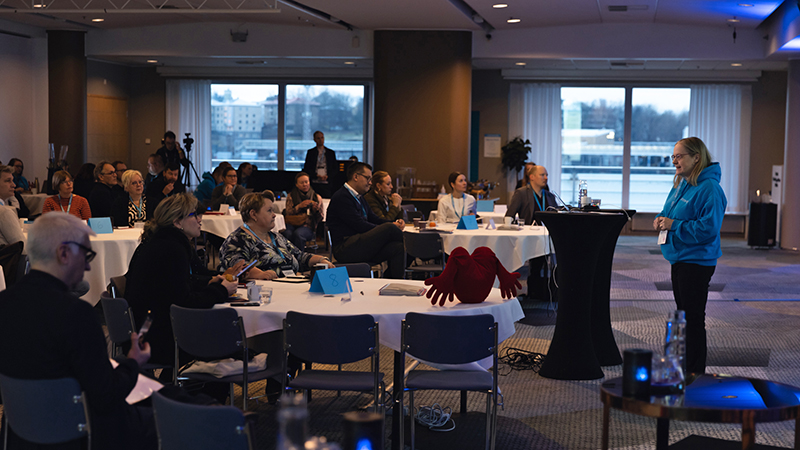
Sirte Pihlaja opened the morning by connecting the two days together. Day One had set the big picture for AI and customer experience. Day Two would focus on hands-on experimentation. She framed the day as an opportunity to experiment, ask questions, and see how AI can be used in real, messy environments rather than idealised slides. Her core reminder stayed the same as on Day One. AI is not the main character. People are. The tools will change, but the target remains improving the lives of customers and employees. With that, the room was ready to dive into the first deep session.
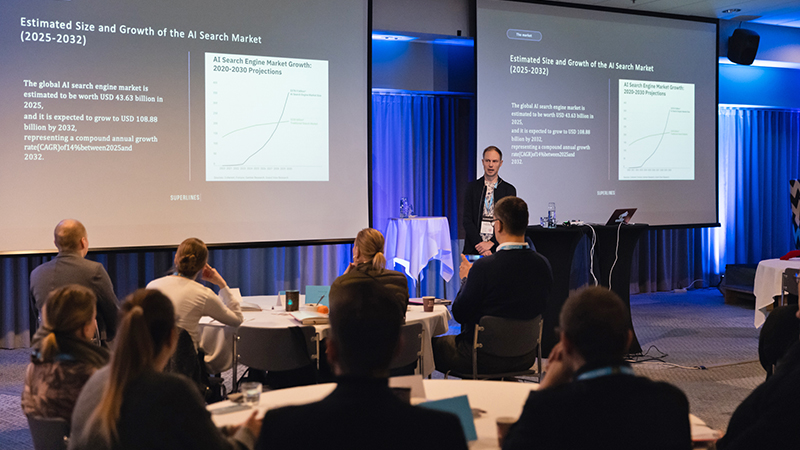
Kimmo Ihanus showed how AI-driven search is quietly rewriting the rules of visibility. Instead of focusing solely on rankings and clicks, he introduced three core metrics for an AI-first world: Brand Visibility, Share of Voice, and Citation Rate. Large language models are becoming the gatekeepers of information. The real competition occurs within AI-generated answers, where brands either appear as cited, trusted sources or do not. If you are not part of the answer, someone else will be.
He explained how prompts to systems like ChatGPT or AI browsers generate curated responses that draw on a limited set of references. Kimmo showed how Superlines tracks this with dashboards that compare Google visibility with AI visibility, and how brand citations move over time. He shared examples such as Taito.ai, which used disciplined, data-driven content and GEO-aware structures to rapidly expand its presence. The message was very clear. Organisations must now design their content so that AI systems can understand, trust and reuse it, or they risk becoming invisible faster than they realise.
As AI transforms how customers find, evaluate, and buy, Sirte Pihlaja and Mika Berglund explored what it takes for organisations to remain visible and relevant, even when their customers may not be human at all.
Sirte reframed the classic line about Google while explaining pioneering research she had done in machine customer experiences: It used to be that if you were not on Google, you did not exist. Now, if you cannot serve machine customers and AI agents, you risk disappearing from customer journeys. Making your site machine-friendly also makes it better for human users.
Sirte explained the three acronyms in simple language: SEO still matters for humans scanning results and clicking. GEO is about making your content understandable and reusable for generative engines and LLMs. AIO is about making your services usable for AI agents and machine customers through structured product data, schema, APIs, and clear service flows that machines can follow. She also described the zero-click reality, bot-dominated traffic, and the fact that AI tools already ingest and summarise your content even when users do not visit your site.
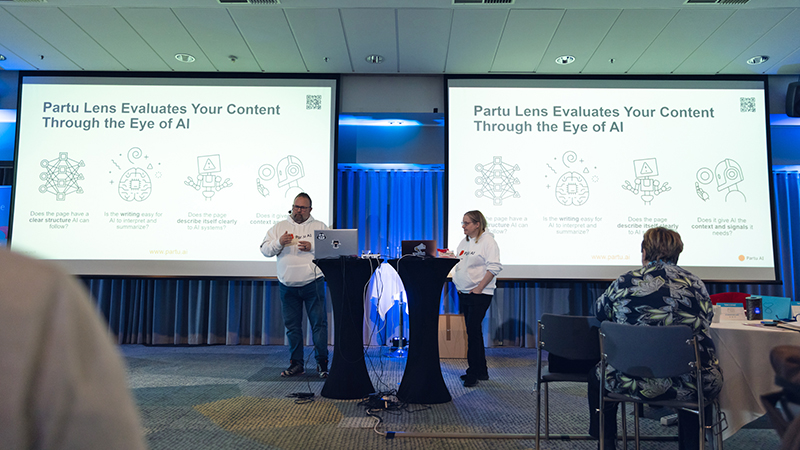
From there, Mika introduced Partu AI and Partu AI Lens. He explained that AI is becoming the first layer of search. Partu AI Lens is your AI sales readiness diagnostic tool, running both traditional and AI-focused checks to analyse the structure, semantics, clarity, Q&A patterns, and metadata of your website. This health check helps teams assess how well their content performs in AI systems.
In a live demo, Mika showed how improving headings, introductions, structured data, and coherence immediately improved scores on their website and blog. Companies can use Partu AI Lens to evaluate their services over time and benchmark their readiness against competitors, tracking progress as they adapt to the AI-driven digital landscape.
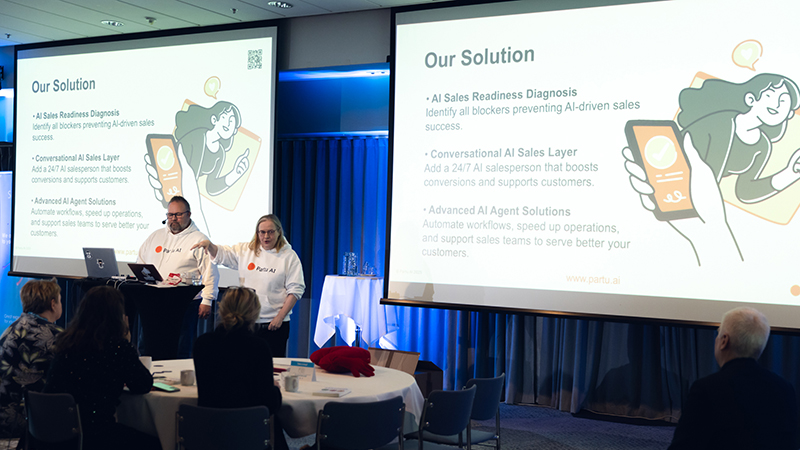
Beyond diagnostics, Partu AI helps organisations turn these insights into action, from optimising digital services and data structures to building AI-ready product feeds that meet the new interoperability protocols of the AI era. This ensures their offerings are discoverable and usable in LLM-based chat environments, where decisions are increasingly made.
Where Partu AI really shines is in conversational commerce and AI-powered customer support, providing the AI agents businesses need to deliver better customer experiences using Artificial Intelligence.
Pasi Örn brought the day firmly into everyday reality by opening up his actual workflows. His approach is mobile-first. At events, he records audio on his phone, sends it for transcription, generates summaries, drafts LinkedIn posts with correct hashtags, and publishes them while still at the venue, before the presenter has even stepped off stage. The signal was simple. AI does not need to be complicated to be transformative.
A central theme was his long-term collaboration with his personal AI assistant AiMO, a companion he has used for more than three years. AiMO helps him learn, train, create music, plan projects and produce content. Pasi described Aimo as a digital colleague that extends his thinking rather than a tool he occasionally uses.
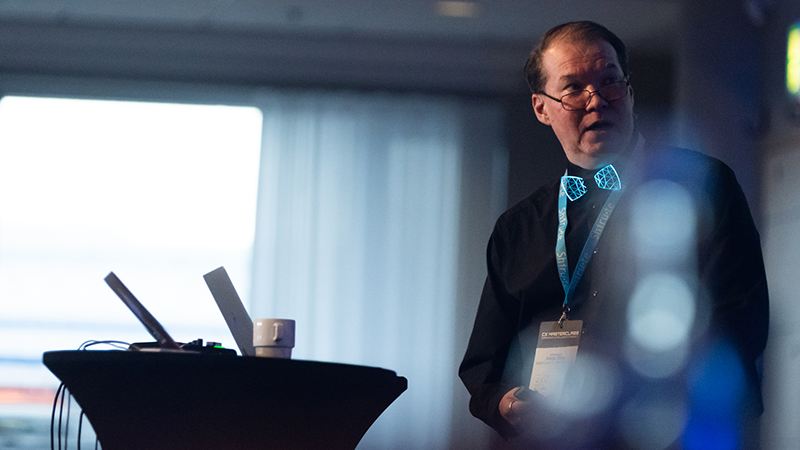
He shared how AiMO helped him win the Elisa AI Vision Challenge after he nearly missed the deadline. With only one day left, they brainstormed concepts, discarded weaker ideas and converged on a super assistant that interacts with all digital services on the behalf of the user. They used Gamma.app to build the slide deck, AI tools for animations, and ElevenLabs for voice. In a few hours, they assembled a full, polished submission that went to the finals and won.
In the discussion, he noted that similar assistants could help anyone, including his mother, once technologies converge. His closing message was that winning with AI is mainly about mindset and habit. Work with it every day, and you create your own unfair advantage.
Our AI twin session focused on helping participants build a personal AI agent that actually sits on their own side. Valto Loikkanen started by framing the core problem. Most AI today is designed to optimise for platforms and companies. Personal AI twins need to be different. They must be built on information that people own and control, and they must represent their interests across roles and over time.

Valto moved on to detailing Prifina’s approach. Models and personal data are separated. The twin acts as the person’s own agent, fully transparent and controlled by its owner. The long-term structure is closer to telecom than social media. You should be able to change providers and keep your number. In this case, your AI identity and information.
We then moved into a live demo showing public-facing AI twins, including professionals and talking products, and walked through creating a twin, adding knowledge, adjusting tone and exploring the interaction history that lives on the individual’s side.
Participants began creating their own twins, and our team assisted throughout the room. We also showed how the same architecture enables Talking Products and Talking Venues, where physical objects and places can speak for themselves and gather insights. The core idea was that apps and tools will come and go, but a well-designed AI twin and the personal information behind it can increase in value over a person’s lifetime.
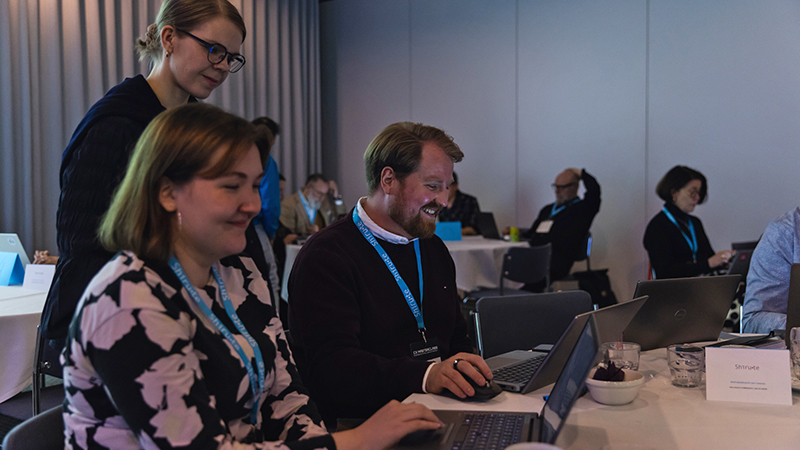
Markku Pelkonen then took the AI twin topic deeper by sharing how he works with his own twin in practice. His background is in education, teacher training and leadership development, with a strong focus on future readiness and life skills. In 2022, he decided he did not want to spend the rest of his career maintaining the status quo in education. He wanted to tackle global-scale challenges. Reaching that scale required more than any single human could do.
Markku explained that his initial experiments with AI twins were essentially chatbots built on static content. They did not feel like him, did not adapt and did not scale his identity. Only when he started working with a model where he truly owns his information did the twin become meaningful. Today, he sees his AI twin as a digital colleague. It reflects his frameworks, his conceptual language and his way of explaining things.
He shared a concrete example from a life skills project in the Emirates. In the past, he would run an intensive three-day workshop and leave participants with hundreds of pages of material that were difficult to revisit. This time, his AI twin was present throughout. He had trained it with more than 600 pages of documentation, over 20 hours of video and detailed topics. Participants could ask him or ask the twin. Many preferred the twin because it was clear, consistent and always available. The twin did not replace him. It amplified and stabilised his contribution.
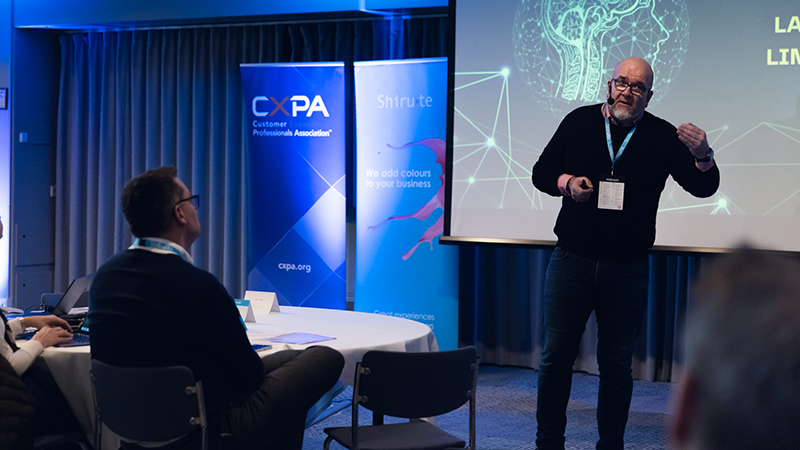
Markku also described how he trains the twin through everyday life. He records voice notes during walks, transcribes them, and adds them to the knowledge base. Over time, this builds not just information, but tone and nuance. He is already experimenting with avatar-based and voice-based twins, and expects to use several versions of himself by 2027, tailored for different contexts but still fully under his ownership. His underlying point was that personal AI twins are not a distant idea. They are already reshaping his work and his ability to have an impact across countries and cultures.
In the afternoon, Espen Varrone shifted the focus from individual assistants and twins to organisation-level agents. He shared how Venli originally explored general-purpose consumer assistants but realised that competing with big tech on generic use cases was not the right path. Instead, his startup focused on hospitality, where his background in Salesforce and hotel operations could be combined with modern AI.
He explained that they built their architecture on MCP (Model Context Protocol). MCP acts as a middle system between user intent and existing systems. Instead of building multiple separate integrations, an instruction layer tells agents how to operate tools such as property management systems (PMS), email, and Salesforce. This makes it possible for a staff member to say something like ”Show today’s arrivals and assign rooms by preference”, and have the agent decide which tools to call and in what order.
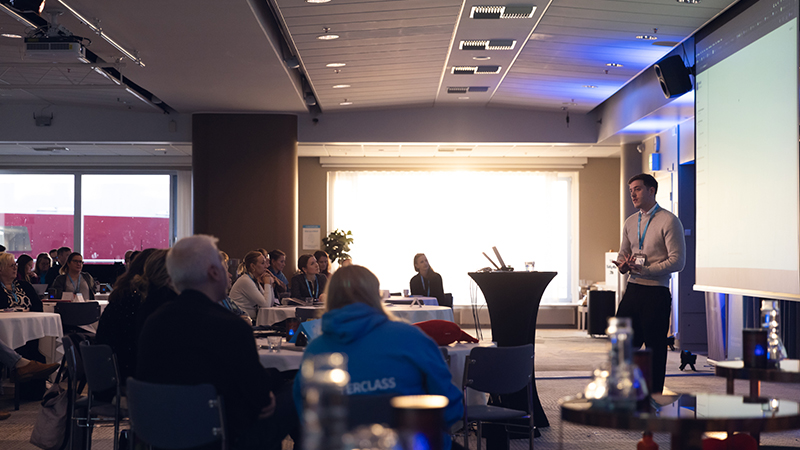
Espen showed both guest-facing and staff-facing use cases. Voice AI, often powered by tools such as ElevenLabs, becomes the main interface. Housekeeping staff can update room status hands-free. Front desk staff can get oral briefings on VIP arrivals. Agents can run in the background, scanning inboxes for booking PDFs, matching them with PMS records and flagging mismatches for human approval. He also demonstrated how modern development looks in this space. Idea, quick prototype using tools like VibeCode and Gemini, then refinement through synthetic conversations and testing.
During the Q&A, he discussed falling model costs, multimodal futures, guardrails, brand safety, and the potential for OTA disruption if such agents become widespread. His main point was that well-designed AI agents do not replace hospitality. They enable staff to deliver high-end, personal service with less friction and greater confidence.
In her session, Iiris Lahti addressed the question that follows after you build powerful agents. How do you govern them? She opened with a personal story about using AI as a triathlon coach, highlighting both the strengths and unpredictability of AI systems. That set up the central challenge. Agents operate with a degree of autonomy, have access to data and tools, and can make decisions quickly. As their numbers grow, so does the need for structured oversight.
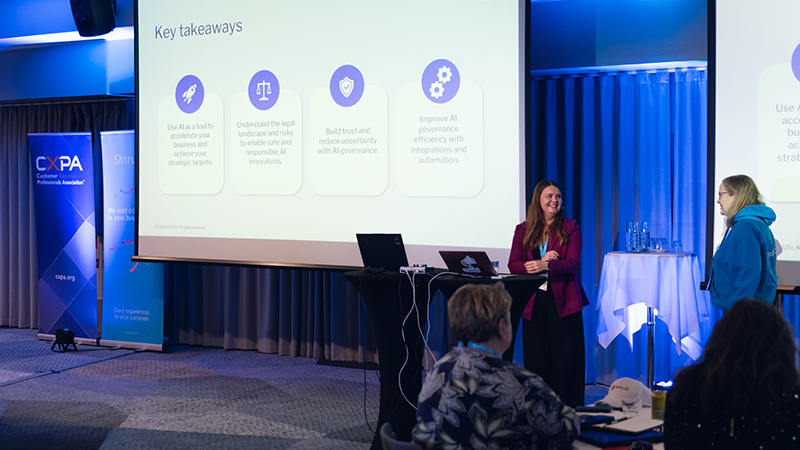
Iiris outlined the evolution from early machine learning systems to fine-tuned models, to embedded copilots and now to autonomous agents and AI browsers. Each step has increased capability but also risk. She talked about issues like hallucinated or overly confident responses, leakage of personal or confidential data, unsafe actions without human oversight and toxic content. She also pointed out that many organisations are stuck in pilot mode because they lack clarity on who owns these risks and how to manage them.
Iiris introduced Saidot’s portfolio-based governance model, which evaluates AI initiatives across two dimensions: strategic importance and risk level. High-impact, high-risk systems, such as customer-facing agents or HR decision tools, require stronger controls. Low-risk, high-value tools can move faster. She showed how Saidot’s graph-based platform links agents, tools, models, data sources, vendors, risks, and controls, enabling organisations to see which agents are exposed to which risks and to reuse mitigation patterns rather than starting from scratch each time.
Her examples covered practical mitigations: prompt engineering, safety filters, access restrictions, systematic evaluations, incident processes and clear documentation. She also explained the need for clear ownership, cross-functional governance forums, and new roles for AI stewards, similar to those in earlier data steward networks. Her closing message was that governance should not slow agents down to human speed. Done right, it removes fear and uncertainty, enabling organisations to innovate faster and at scale.
Juhani Honkala viewed the same shift from both product and interface perspectives. He drew on his background in building early free-to-play games in Korea, helping Rovio scale and creating tools that enabled others to build as well. His work has always been about empowering people to create. AI now allows that at a completely new level.
Juhani argued that modern technology stacks have become noisy and slow, and that AI can reverse this trend. If you can clearly describe what you want, you can now have agents generate full applications, connect to data, and orchestrate multiple coding agents in parallel. He described projects that other teams had taken years to deliver, which his team could now build in weeks. The bottleneck is no longer the technology. It is clarity of intention and understanding of value.
He showed how agentic AI can create not just interfaces, but entire flows, with agents creating other agents, reviewing code and running feedback loops. He emphasised that the best technology disappears into the background. AI should be quiet and almost invisible, enabling humans to focus on outcomes and experiences. That makes service design and human-centred thinking more critical than ever.
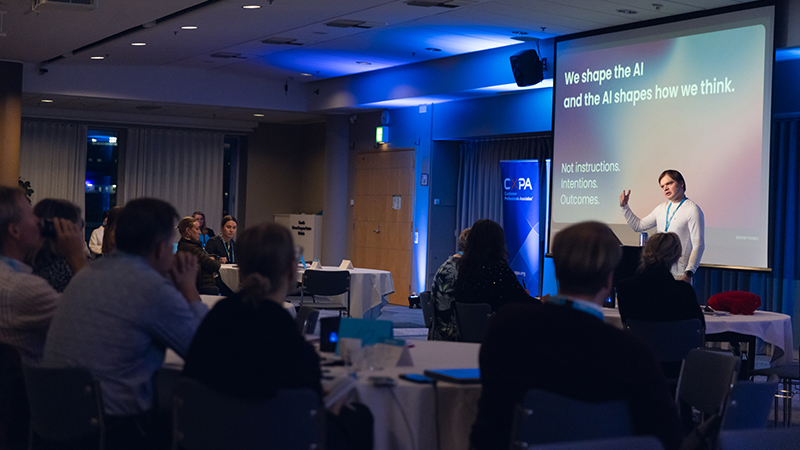
Juhani also mentioned an upcoming designer-focused hackathon where companies can bring use cases and work with this new way of building. His warning was straightforward. Organisations that do not adopt agentic approaches risk falling behind at a pace they cannot later fix.
Reidar Wasenius closed the speaker programme with a provocative but grounded session. His core idea was that AI amplifies whatever is already there. If your thinking, habits and systems are chaotic, AI will scale the chaos. If you are structured, disciplined, and clear, AI can scale you to a level previously not possible.
He drew on his background as a widely heard voice in Finland, from railway and operator announcements to voice entrepreneurship, as well as his experience as a brain trainer and founder in voice AI. He explained key concepts, including generative AI, large language models, and, in particular, memetic AI, which learns and replicates human patterns. Because humans themselves are highly patterned, they can be replicated and extended digitally to a surprising degree.
Reidar asked the audience to think carefully about how they relate to AI: as a tool, a slave, an assistant, a sparring partner, a colleague or even an unexamined boss whose outputs they pass on without checking. He argued that in many workplaces, AI is already acting as a quiet boss, because people are delegating thinking to it without oversight.
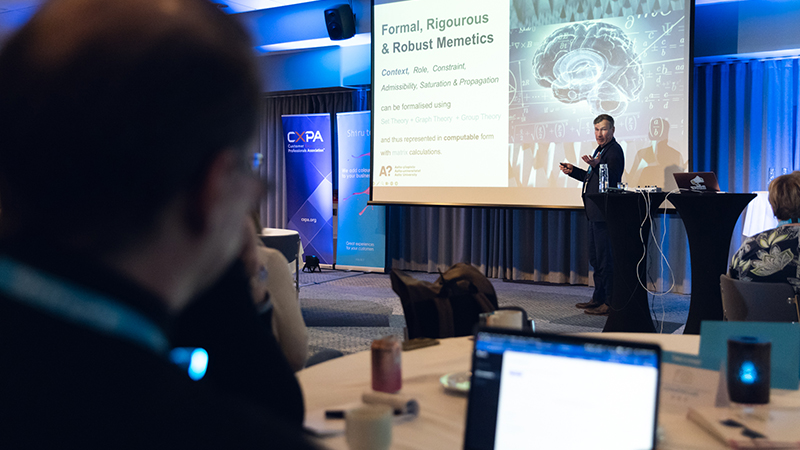
On the business side, he discussed scalability, network effects, and business models that do not scale workload linearly with customer count. He pointed to platforms, SaaS, and online services and stressed the importance of choosing ideas that are possible to automate, not heavily regulated, and focused on intangible value. He also described the need for employees to build their own ”personal business model” in an AI world, where one person plus AI can equal the output of several colleagues.
Reidar touched on solopreneur psychology, company-in-a-box futures, mass customisation, and the importance of trust and safety when agents act on our behalf. He cited work such as METR to evaluate model reliability before delegating too much. He also touched on Finnish culture, ownership of ideas, and the risk of getting stuck in envy rather than execution.
His closing point was simple. Somewhere in the world, likely in Asia first, we will see extremely small teams or even one-person companies reach massive scale with AI. The tools are already here. The question is who chooses to use them consistently, week after week.
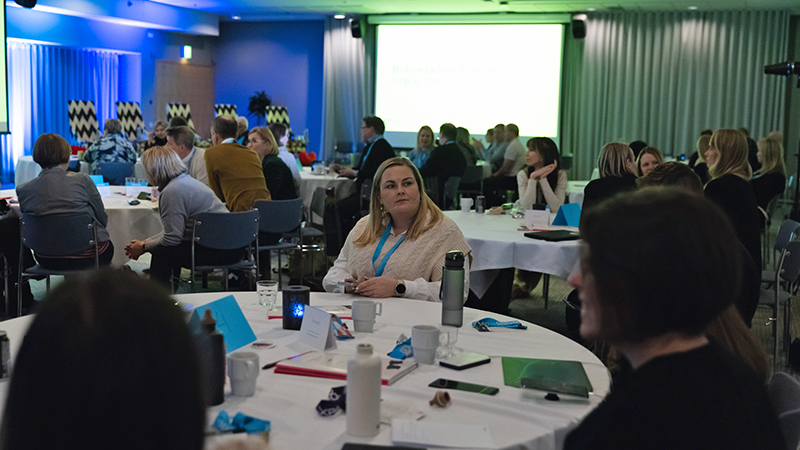
Sirte Pihlaja, CEO, Shirute and Head of Team, CXPA Finland
To close out the two days, Sirte Pihlaja returned to the stage to pull the threads together and highlight ongoing learning resources. From machine customers and AI search, to AI twins, to agents, governance and new interfaces, the message was consistent. AI has no value in itself. It matters only when it improves human value and experience. She thanked the speakers, organisers, volunteers and participants, and reminded everyone that the learning does not end with the event.
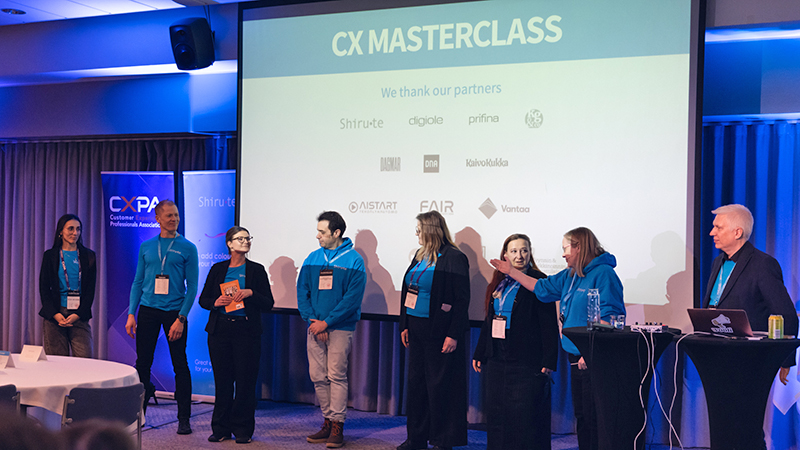
Day Two made it clear that AI is no longer abstract. You can start now. You can tune your content so AI systems can read and reuse it. You can use assistants like AiMO in your daily workflows. You can build an AI twin that grows with you. You can deploy agents that empower staff, govern them responsibly, and begin moving from websites to agentic experiences. None of this requires waiting for a future AI version. It requires clarity about what matters and a human-first mindset.
The recordings from both days of the AI and CX Masterclass are available for purchase (www.cxmasterclass.fi), and the replays are free to watch for event attendees. Given how much practical, timely insight was packed into Day 2 alone, they are worth revisiting more than once as AI and customer experience continue to evolve at high speed.
If you haven’t read it by now, take your time to explore the first part of this blog series, summarising Day 1 of the CX Masterclass. We will also publish individual posts that dive deeper into each of the main topics and key findings from the Masterclass. These will explore the insights from the speakers, the frameworks they shared, and the patterns that emerged across both days.
If you found the overview useful, I recommend following the upcoming articles. The quality and depth of the content delivered at this event were exceptional, and the themes are important enough to warrant revisiting. Each topic offers a new angle on how AI can meaningfully improve customer experience, leadership, and everyday work, and the next articles will break those ideas down into actionable steps.
Stay tuned…
Valto Loikkanen is the Co-founder of Digiole and Prifina. Both companies were our partners co-hosting this event.
Want to see the CX Masterclass talks? They are now available on our event site until Dec 31st, 2025.
CX Masterclass was organised in Helsinki this November by CXPA Finland, Shirute and partners.
Additional information:
CEO Sirte Pihlaja, tel. +358 50 5700 190