



CX Masterclass
Want to see the CX Masterclass talks? They are now available on our event site until Dec 31st, 2025.

“ At this year’s AI & CX Masterclass, we heard a wide range of perspectives on how AI is already reshaping customer experience. One of the most energetic and content-rich talks of the day was Kieran Gilmurray's keynote on CX & AI Agents. “
As a partner of the event, and as someone building personal AI twins at Prifina and AI-powered product and venue experiences at Digiole, I found Kieran’s session especially aligned with what we see on the ground: customer journeys are increasingly mediated by AI systems long before they reach a brand’s own channels.
Kieran began with a simple but important observation: customer expectations have moved beyond the classic “Amazon experience,” and have done so for some time. People know they can have more personalised, faster and smarter experiences.
He noted that customer journeys are now beginning within large language models such as ChatGPT, Claude, DeepSeek, and Perplexity. These systems interpret, summarise and recommend products and services. In practice, this means customers often first encounter AI, not the brand.
As Kieran framed it, CX leaders now have two audiences: the human customer and the AI systems that interpret your content, products, and services on their behalf.
If your content is not discoverable, interpretable, and actionable by AI, it is increasingly invisible to the point where decisions start.
Kieran then moved from search to agents: AI workers that are given a goal and mission and can operate with relatively minimal supervision, provided they are properly configured and monitored.
He demonstrated real-life examples of AI-powered customer service interactions: a voice agent that handled a warm transfer call and sounded calm, helpful and emotionally intelligent, and a video agent that noticed a user putting on glasses, offered to switch to a clearer table view and continued the conversation smoothly.
What stood out was not “chatbots as we know them”, but agents that guide the conversation, gather information, prepare summaries and support the human specialist. In some cases, they can even sound more emotionally intelligent than the human on the other side of the call.
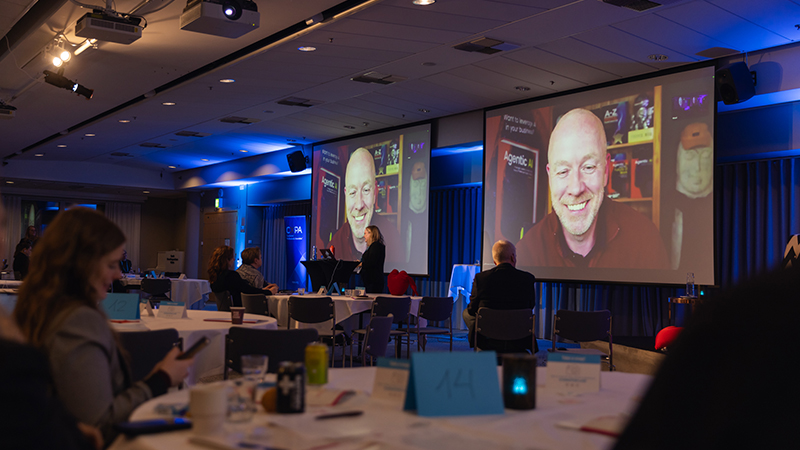
A central theme in Kieran’s talk was the need to design content for AI consumption, not just for human reading.
He showed how customer journeys and discoverability are evolving as more people use AI systems to make richer, more complex decisions. To show up in those journeys, organisations must adapt their content so that AI systems can:
Kieran used the lens of search and optimisation concepts such as GEO and AI-driven optimisation alongside traditional SEO. The practical message was clear: add structure, such as TLDR sections and FAQs, and use clear, unambiguous language so AI systems can parse, summarise, and surface your content accurately.
Static, flat pages and long, unstructured articles are at a disadvantage in this new environment.
Kieran repeatedly connected AI and CX back to business outcomes. If AI and agents do not translate into value, they are just added cost.
He highlighted value categories such as faster resolution times, higher-quality decisions, improved discoverability, higher conversion rates and reduced operational costs. These are the metrics that matter at the executive table.
His recommendation was to start small and concrete: pick one CX process that is highly repetitive and digital, and experiment with no-code/low-code tools (e.g., platforms comparable to Zapier, Copilot Studio, or Zendesk-type tools) to automate parts of it. At the same time, optimise the underlying knowledge and content so it is written clearly for both humans and AI.
This way, teams can move fast without waiting for large engineering projects, while still keeping a clear line of sight to profit and loss.
During the session, Kieran also noted that the incoming workforce is both digital and AI-native. He shared a story where his son automated a task in a couple of hours using tools like Zapier and agentic AI, instead of doing it manually over two weeks.
For organisations, this means employees’ expectations are shifting: they expect automation, real-time tools, and meaningful, challenging work.
Kieran’s view was that future roles across functions will increasingly require a full-stack combination of skills: curiosity, emotional intelligence, data and analytics, automation, customer understanding and basic financial literacy.
People, processes and AI need to evolve together, with clear career paths aligned with the technology and business strategy.
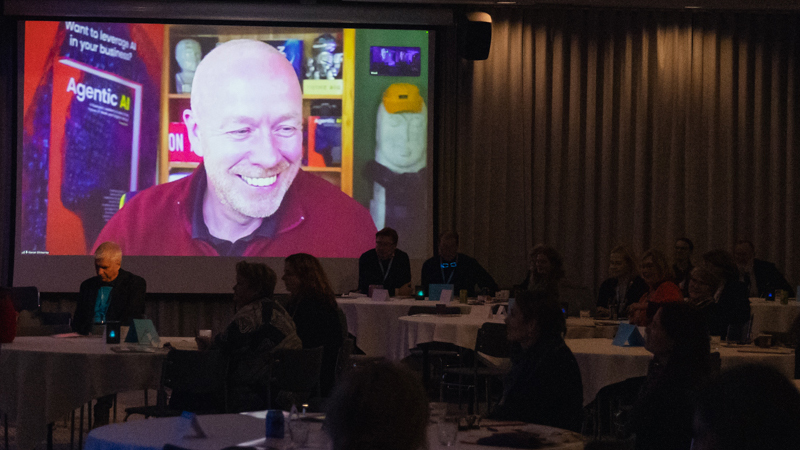
During the Q&A, Kieran received a question about how to measure customer experience when AI agents are serving customers, and traditional surveys already suffer from low response rates.
He acknowledged the problems with long, poorly designed surveys that lead to drop-offs and rarely result in visible follow-up. Instead, he suggested leveraging tools that already exist in many organisations: call recordings and transcriptions from telephony platforms.
His concrete suggestion was to:
From there, he recommended using AI again to research best practices from leading companies and convert the findings into practical CX improvements that fit within realistic time and budget constraints.
The main point: feedback doesn’t disappear just because surveys are weak. It is there in conversations and behaviour, and AI gives us a new way to analyse it at scale—provided we keep humans in the loop and keep iterating.
Another important reminder Kieran gave – both in his talk and answers – was that AI agents and systems are not a “set and forget” solution.
Just as we learned with traditional chatbots, if we don’t maintain and train them, and analyse the conversations and outcomes they produce, their usefulness declines and frustration grows.
Agents need continuous supervision, evaluation and improvement. They are an extension of great human talent and experience, not a replacement for leadership, design and ongoing CX work.
For us at Prifina and Digiole, Kieran’s session resonated strongly with the direction we are heading:
Agentic CX is not a distant future scenario. It already exists today in pilots, early implementations, and fast-moving organisations that are willing to learn and adapt.
If you want to explore these ideas further, ask follow-up questions or test how this thinking applies to your own context, you don’t need to wait for the next event.
Kieran has a personal AI twin that you can interact with directly and asynchronously.
Kieran’s AI Twin:
https://hey.speak-to.ai/kieran-gilmurray
Kieran’s LinkedIn:
https://www.linkedin.com/in/kierangilmurray/
You can ask questions, revisit themes from the AI & CX Masterclass or explore how AI agents, search and optimisation could impact your own customer experience. The AI twin responds based on Kieran’s thinking and expertise, extending his 30-minute keynote into an ongoing, interactive conversation.
The full set of recordings for both days of the AI & CX Masterclass is available to purchase (www.cxmasterclass.fi), and is worth watching for anyone interested in where customer experience is heading. The replays are free to watch for the live event attendees.
If you haven’t read it by now, take your time to explore the first part of this blog series, summarising Day 1 of the CX Masterclass, and the second part of this blog series, summarising Day 2 of the CX Masterclass. We will also publish individual posts that dive deeper into each of the main topics and key findings from the Masterclass. These will explore the insights from the speakers, the frameworks they shared, and the patterns that emerged across both days.
Valto Loikkanen is the Co-founder of Digiole and Prifina. Both companies were our partners co-hosting this event.
Want to see the CX Masterclass talks? They are now available on our event site until Dec 31st, 2025.
Asiakaskokemuksesta kertova “Customer Experience 2” -kirja ampaisi heti julkaisunsa jälkeen globaalien myyntitilastojen kärkeen. Se nousi Amazonin best seller -listojen huipulle, sijoittuen ykköseksi mm. Customer Service- ja Consumer Behaviour -kategorioissa useissa eri maissa (esim. USA, UK, Kanada ja Ranska). Kirjan kirjoittajat ovat nyt Best Selling -bisneskirjailijoita kolmessa eri maanosassa. Shiruten toimitusjohtaja, Sirte Pihlaja, on yksi kirjan kirjoittajista. Hän kirjoitti teokseen asiakaskeskeisestä kulttuurista korostaen leikin ja luovuuden roolia bisneksessä.